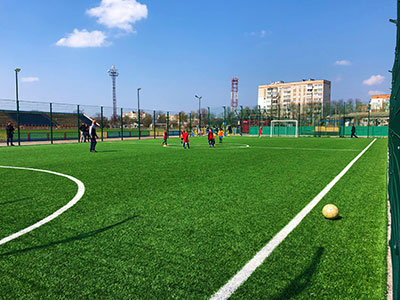
Artificial Grass
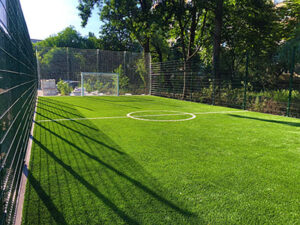
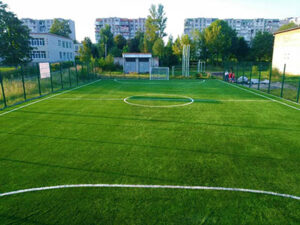
Artificial grass is a synthetic roll coating consisting of volumetric polypropylene or polyethylene fibers (pile) that imitate grass blades. The fibers are firmly connected (stitched) to an elastic polypropylene backing, which is coated (laminated) with latex.
This type of surface is designed for use on outdoor facilities such as:
-
sports grounds: football, rugby, tennis, golf, field hockey, etc.;
-
multifunctional sports fields;
-
children’s playgrounds;
-
recreation areas, landscaping projects, decorative elements, etc.
Production Technology and Types
Artificial grass is a textile material produced by the modern carpet manufacturing method — tufting.
Depending on the degree and type of infill, artificial grass is divided into three categories:
-
non-infill,
-
semi-infill,
-
infill.
Common infill materials include quartz sand, rubber granules (SBR), or synthetic rubber (EPDM).
Artificial grass also differs by fiber type:
-
monofilament (solid, un-split fibers),
-
fibrillated (wide fibers with longitudinal splits).
Depending on its purpose, artificial grass may have different technical characteristics — pile height (from 5 to 70 mm), fiber shape and thickness, density, weight per square meter, etc.
Base and Installation
Artificial grass serves as the working surface of sports, multifunctional, and children’s playgrounds. It is usually installed on a prepared, compacted, and leveled crushed stone base, which also acts as a vertical drainage layer thanks to perforations throughout the grass backing.
Installation is carried out mechanically (by machine) or manually. Rolls of artificial grass are bonded with two-component polyurethane adhesive or stitched together with special threads. Afterwards, field markings are cut in and filled with appropriate infill materials.
Installation Conditions
Since the installation process consists of several stages, favorable weather conditions, air temperature, and humidity levels are essential.
For proper installation and long-lasting durability:
-
relative air humidity should not exceed 75%,
-
air temperature should not be lower than +15 °C,
-
the base surface must be dry and free of dew or precipitation.
Key Advantages of Artificial Grass
-
environmentally friendly and safe for people,
-
injury-safe, reducing stress on joints and spine,
-
high wear resistance,
-
long service life without loss of properties,
-
easy to maintain and repairable,
-
resistant to temperature fluctuations and UV radiation.
Maintenance Recommendations
To prolong the lifespan of artificial grass and prevent premature wear, it is recommended to:
-
avoid use during heavy rainfall and for 2–4 hours afterwards (depending on drying speed);
-
avoid use when ice or frost is present;
-
prohibit access in spiked shoes (cleats) or high heels if the turf is non-infill and pile height is under 50 mm;
-
regularly maintain the surface: brush the fibers, loosen the infill, and add material in high-use areas (e.g., penalty zones of football fields).
Important
All installation materials (adhesive, joining tape, quartz sand, rubber granules) have the necessary quality and compliance certificates. Artificial grass and its components have undergone laboratory testing and are certified according to international standards.